Establishing Standards for IT System Development and Consultancy Services: Insights from the IT Norms 2082/83.The salary of an information technology officer in Nepal will be up to Rs. 500,000.
Introduction
In today’s digital era, information technology (IT) has become the backbone of governance, business, and service delivery. Recognizing the critical role of IT systems, the Government of Nepal has introduced IT Norms 2082/83 to standardize cost estimation for IT system development and consultancy services. Issued under the authority of the Ministry of Communication and Information Technology (MoCIT), these norms are designed to provide a uniform framework for public organizations while procuring IT-related services. The document serves as a guiding instrument that ensures fairness, transparency, and efficiency in budgeting IT projects.
This article provides an in-depth overview of the objectives, structure, expert categories, and broader implications of these norms, highlighting their significance for public institutions, IT professionals, and the digital transformation of Nepal.
Background and Rationale
The rapid expansion of digital governance initiatives, cybersecurity requirements, and data-driven decision-making has created an urgent need for well-defined IT service frameworks. Prior to the establishment of these norms, government agencies often faced challenges in cost estimation for software development, system maintenance, and consultancy services. Disparities in professional qualifications, remuneration rates, and project evaluation led to inconsistent practices and sometimes inefficiencies in resource allocation.
To address these gaps, MoCIT introduced the IT Norms 2082/83 as a standardized reference. Built upon provisions of the Public Procurement Rules (2064), these norms empower government institutions to develop IT systems in a cost-effective, accountable, and technically sound manner.
Key Provisions of the IT Norms 2082/83
1. Official Title and Implementation
The framework is formally titled “IT System Development and Consultancy Service Cost Estimation Norms, 2082.” It came into effect immediately upon publication, mandating all public entities under MoCIT to apply these standards in their IT-related projects.
2. Technical Qualifications and Expertise
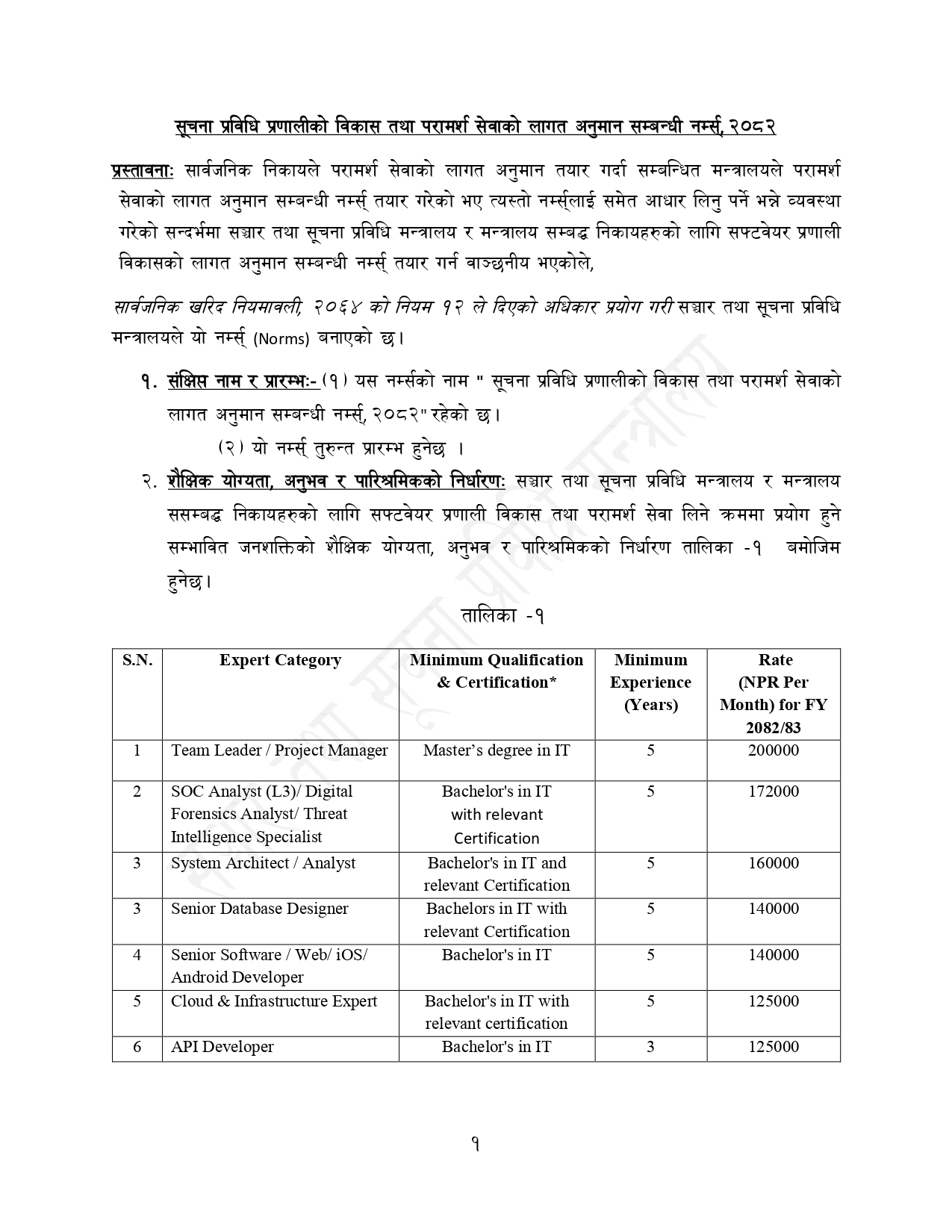
One of the most significant aspects of the norms is the detailed classification of experts required for IT system development and consultancy. Table 1 in the document provides clear guidelines on minimum academic qualifications, certifications, years of experience, and monthly remuneration rates for various IT roles.
3. Categories of Experts
The framework identifies multiple levels of IT professionals, ranging from top-level leadership to junior developers. Key categories include:
-
Team Leader / Project Manager – Requires a Master’s degree in IT and at least 5 years of experience. Monthly remuneration is set at NPR 200,000.
-
SOC Analyst (L3) / Digital Forensics Specialist / Threat Intelligence Expert – Requires a Bachelor’s in IT with relevant certifications and 5 years’ experience, at NPR 172,000.
-
System Architect / Analyst – Bachelor’s in IT with certifications and 5 years of experience, paid NPR 160,000.
-
Senior Developers (Web, iOS, Android, Software) – Bachelor’s in IT with 5 years’ experience, at NPR 140,000.
-
Cloud & Infrastructure Experts – Bachelor’s degree with certifications, at NPR 125,000.
-
API Developers – Bachelor’s in IT with 3 years’ experience, at NPR 125,000.
-
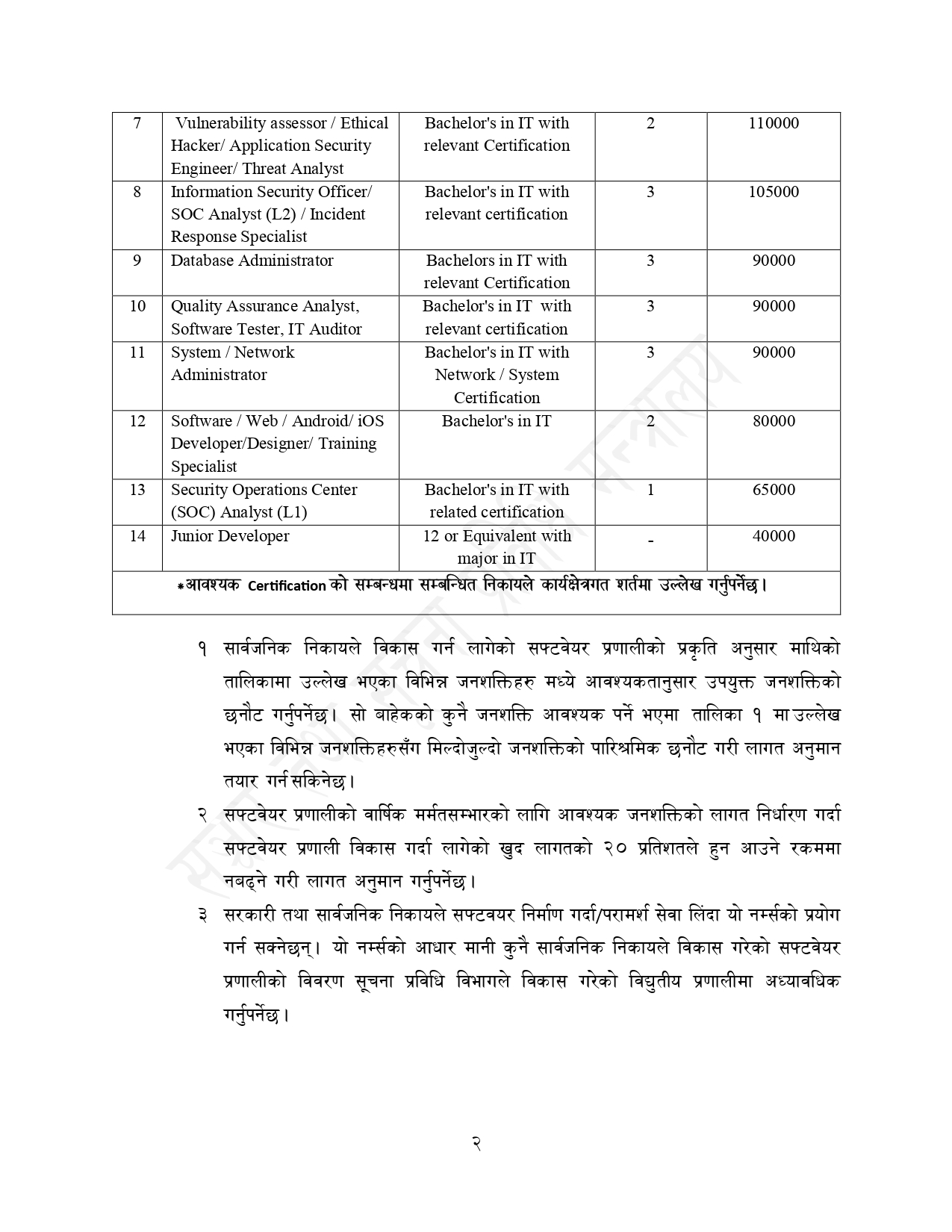
Ethical Hackers / Vulnerability Assessors / Security Engineers – Bachelor’s in IT with certifications and 2 years’ experience, at NPR 110,000.
-
Information Security Officers / SOC Analysts (L2) – Paid NPR 105,000.
-
Database Administrators, QA Analysts, Network Administrators – Salaries range between NPR 90,000 to NPR 105,000.
-
Junior Developers – IT diploma holders, earning NPR 40,000 per month.
This structured classification ensures that institutions hire experts with the right balance of education, certification, and practical experience, while maintaining standard salary scales across government projects.
4. Flexibility in Hiring
While the norms provide clear categories, they also recognize the diverse nature of IT projects. Organizations are allowed to select additional experts if necessary, provided their remuneration aligns with existing classifications. This flexibility helps tailor project teams according to the specific technical needs of software development, cybersecurity, or system integration.
5. Maintenance and Sustainability Costs
The norms emphasize that IT projects are not limited to initial development but also include long-term sustainability. Specifically, annual maintenance and support costs should not exceed 20% of the total development cost. This provision ensures that systems remain functional and updated without imposing excessive financial burdens.
6. Application and Oversight
The norms are binding for public institutions and government organizations that seek to procure IT services. Additionally, the Department of Information Technology (DoIT) is tasked with overseeing compliance, ensuring that systems developed under these norms are integrated into national electronic platforms where required.
Importance of IT Norms 2082/83
1. Promoting Transparency and Accountability
Standardized cost estimation reduces arbitrary pricing and prevents irregularities in IT procurement. By establishing clear salary benchmarks for experts, the government ensures transparency in budgeting and fair remuneration for professionals.
2. Strengthening Digital Governance
Nepal’s ambition to achieve digital governance and e-services relies heavily on robust IT systems. These norms lay the foundation for reliable, cost-effective, and sustainable systems that directly support e-governance initiatives, digital security, and service delivery.
3. Professionalization of IT Services
By defining qualifications and certifications, the norms encourage IT professionals to pursue higher academic degrees and international certifications. This strengthens the overall talent pool and aligns Nepal’s IT sector with global standards.
4. Enhancing Cybersecurity Readiness
The inclusion of roles such as SOC analysts, digital forensics experts, ethical hackers, and incident response specialists reflects Nepal’s growing awareness of cybersecurity threats. This ensures that systems are not only developed but also secured against vulnerabilities.
5. Cost Efficiency and Resource Optimization
With uniform guidelines on development and maintenance costs, public institutions can better manage budgets and allocate resources effectively. This also reduces duplication of efforts across ministries and promotes collaboration.
Challenges and Considerations
While the IT Norms 2082/83 mark a significant step forward, certain challenges may arise:
-
Implementation Gaps – Ensuring all government bodies adopt these norms consistently may take time.
-
Private Sector Alignment – The norms primarily target public entities, but harmonizing them with private sector practices could enhance overall IT ecosystem efficiency.
-
Certification Accessibility – Some certifications required for roles may not be easily accessible or affordable for Nepali professionals, potentially limiting the talent pool.
-
Rapid Technological Changes – With technology evolving quickly, the norms will need periodic updates to stay relevant in areas like AI, blockchain, and quantum computing.
More Details Click Here
Conclusion
The IT Norms 2082/83 represent a milestone in Nepal’s journey toward digital transformation. By standardizing cost estimation for IT system development and consultancy services, the government has laid a strong foundation for transparency, accountability, and professionalization in the IT sector. These norms not only safeguard public funds but also encourage the development of a skilled IT workforce capable of addressing modern challenges, particularly in cybersecurity and digital governance.
As Nepal continues to embrace digitalization, the successful implementation of these norms will play a pivotal role in ensuring that IT systems are built on principles of sustainability, cost-effectiveness, and global best practices. With periodic updates and broader collaboration between public and private stakeholders, the IT Norms 2082/83 can serve as a blueprint for a resilient and innovative digital future in Nepal.